

The Wing Commander & Rifleman

Updated: 6 days ago
As Anzac Day approaches, reflection, remembrance & resolve are top of mind
This reflection is personal and important. It also touches on questions of deep individual and social values that are universally relevant. It also rejoins themes raised in Drunken Monkeys regarding the fundamentally self-interested nature of the primate ergo human mind and how, at our best, we rise above our ape-brained egocentricism.
Anzac season has always evoked a gnawing question that I think most of us have had at some point in our lives: how do men go to war? A free range child engaged in all-day neighbourhood games of war (Wayne Thompson’s dad Kelvin, made him wooden rifles the Neave Place pre-teen militias coveted very much. Most of us had broken broom handles or flax stalks), even then I wondered at how a person reconciled the call to duty with the horrors entailed. And the likelihood of never returning. Nearly half a century! later, the combination of parenting and better sensing the familial cycle, that odd echo of past and future generations, helps frame that call to fate, as incomprehensible as it remains. And in any case, who is to know what is in anyone else’s mind at the best of times let alone 100 years ago in the worst of times.
The scene from Christopher Nolan’s Interstellar comes to mind: Dr Mann’s (Matt Damon, always lost and at sea - Odysseus, Good Will, The Martian...) deception and betrayal of Cooper to his apparent death. “What does research tell us is the last thing you’re going to see before you die? Your children. Their faces. At the moment of death, your mind’s gonna push a little bit harder to survive. For them.” There is insight into the will to live in this, which includes consideration beyond selfish self preservation. At our best, when pushed, we shed the calculating ape and act with nobility.
But enough. For now, with Anzac day a week or so away, we will put this skuldiggery to one side to remember people and a time where a sense of purpose and duty to something larger than self was more to the fore than the contemporary call to “looksmax” for instagram or “humblebrag” on Linkedin.
This reflects on the remarkable circumstances of WW I & II, from the perspective of Caroline and my families’ roles therein through two stories; George Jackson, my great great uncle who served in WW1. And Michael Everest, Caroline’s grandpa, whose WWII service is much better documented and remains within living memory.
Both examples say much about values. Both then and now. And have a particular resonance against the backdrop of current recklessness and carnage. For this piece, our duty is to reflect on and remember the examples of George and Michael. And take heart to act well and with purpose in our own endeavours.
Wing Commander Michael Henry de Lisle Everest
Lieutenant of the Royal Victorian Order / Air Force Cross / Military Order of Aviz, commander. Portugal
There is a legitimate Smiley’s People spy in the family! Caroline’s grandpa.
Michael Everest hailed from the gorgeous market town of Shrewsbury in the Hobbity Shropshire West Country. In 2019, we visited Shrewsbury with Roger, Caroline’s Dad. He and I snuck off to tour the Jaguar Landrover plant up the road in Solihull. Excellent. I digress… but gee it was a fantastic day out! Michael relished life. He apparently loved schooling in Shrewsbury. Was a formidable rower and cross country runner, earning his colours in each. In 1932, at 20 years of age, Michael was commissioned as a Second Lieutenant with the Royal Tank Corps. And from here his world changed in ways that surely he could not have imagined. His first steps outside his Shropshire Hobbit-hole swept him to all parts of the globe - much of which he saw from great heights with the RAF. Much he saw up close in the freighted and taut world of Eastern Bloc espionage. A remarkable life.
Two years after his time in tanks, Michael joined the RAF. Memories of how this switch occurred are lost. But, being an Everest, he will have demonstrated his qualities as someone with capacity to soar in every sense. He was posted immediately to Egypt to train and served a near unheard of 4 years on his first tour with 101 Bomber Squadron operating over Europe. He far exceeded his luck as well as the allotted tours of duty before being “rested” from active operations to serve as a flying instructor.
Caroline is a miracle.

Two years of “stand down”, then back in the cockpit attached to the Royal Australian Air Force flying missions in the Pacific Theatre. He served with the Australians for nearly two years and was posted back to the UK as Commanding Officer of 101 Squadron, Bomber Command based at RAF Manby in Lincolnshire between 1943-45. Michael’s duties there included teaching at the Empire Air Armament School. This is likely to be when Michael’s intelligence career path began to open up. RAF High Wycombe was home at the time to the United States Army Air Forces, 325th Photographic Wing.
The return journey from Australia, with two young boys, Simon and Tim, and Norah heavily pregnant with Roger, was by 25,000 MT tanker. It tracked across the Pacific and up the Atlantic. The threat from German pocket battle ships and U-Boats was ever present. No pleasant sea cruise.
Thor & Thor II
At the end of the war, a decorated and highly successful “bus driver” (how fighter pilots referred to bomber pilots!), Michael had amassed remarkable experience and flying hours. He would earn more in the Thor missions from 1945 to 1947.

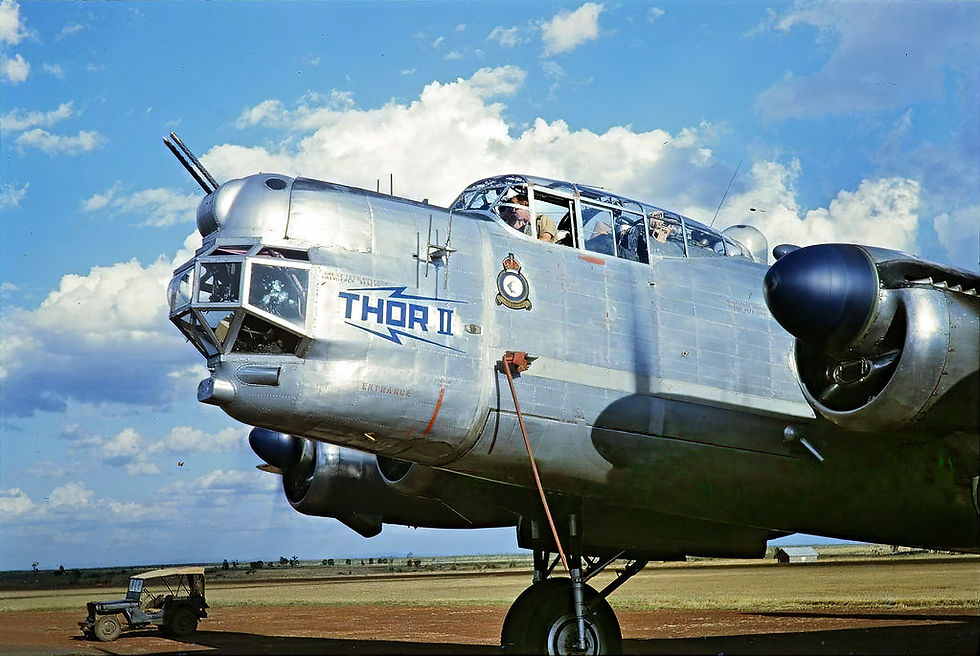
Thor and Thor II were goodwill tours across the Empire including the Middle East, Rhodesia, South Africa, Canada, USA, Australia and New Zealand. The first mission was flown in the iconic Mk.I Avro Lancaster bomber, PB873. This plane flew with the 460 Squadron RAAF, 49 Squadron, and the Empire Air Armaments School where Michael was assigned.
Thor II missions were flown in the top of the line replacement to the Lancs, the Avro Lincoln. A read of the RAF mission statement for Thor II leaves no room for doubt about how proud the British were of this revolutionary bomber. These missions were a mix of goodwill, info sharing with Allies on air warfare techniques and new technologies. Reading between the lines, Thor II was also a sales campaign!
![Original wartime caption: Some of the Thor’s crew and members of the Mission. Left to right - F/O Grantham Hill, DFC [Flight engineer] F/O A. Wood [wireless operator] Wing Commander M.H. de L. Everest [captain of aircraft] Flight Lieutenant J.C. Martin (navigator) Flight Lieutenant D.A. Henry, DFC [second pilot] Flight Lieutenant E.J. Suswain, DFM [bombing leader] Flight Lieutenant R.T. Bromwich [gunnery leader] Squadron Leader P.L. Arnott, DFC & Bar [pilot attack instructor] Corporal F.H. Brittain [instrument mechanic]....](https://static.wixstatic.com/media/baa2d8_e85fb18be88d49c191776e15f03ac18a~mv2.png/v1/fill/w_834,h_612,al_c,q_90,enc_avif,quality_auto/baa2d8_e85fb18be88d49c191776e15f03ac18a~mv2.png)

Roger recalls Michael speaking about the crew being somewhat teary-eyed as they took off from Whanganui, ending the NZ leg of their tour, in 1946, enroute to Australia. And being concerned about flying into Mount Taranaki - which leads one to wonder whether they did go close as they headed West?
Just Ducking Behind the Iron Curtain for a Bit…
Michael was clearly adept at threading needles and operating within (and perhaps slightly beyond) consequential risk and flight plan envelopes. Following Michael’s RAF flying career his James Bond, Frederick Forsyth phase began. Michael's dexterity and ease in risky situations no doubt marked him as a useful asset. Michael was assigned to BRIXMIS, the British Commanders’-in-Chief Mission to the Soviet Forces as Chief Intelligence Officer, Security Officer and Public Relations Officer posted in Potsdam, the Russian Zone, in Berlin, West Germany between 1949-51. The Iron Curtain had been newly drawn following the Berlin Blockade and Allied Airlift. One can only imagine the febrile tension and nervousness as strains of Nazism went underground in the face of the Allied presence and while the Soviet menace rose. The seeds of what would become the fetid bloom of the Stasi were germinating. Great Power rivalry and unfathomable individual precariousness all playing out well after the end of formal hostilities. A very long way from bucolic Shropshire.
There is no record of what Michael’s specific duties might have been in Germany. Certainly intelligence gathering and monitoring relating to military activity, Nazi resurgence and the like. No doubt propaganda work to win over the German population to Western worldviews as the Soviets pushed their agenda in the region and in theatres around the world. And without question Michael would have engaged in diplomatic overtures in the form of social soirees with Soviet liaison officials and attaches, in the service of preserving peace and friendly relations. Perhaps these afforded some enjoyment and relief. It is hard to imagine that at this distance but perhaps.
BRIXMIS was responsible for notable clandestine, and surely highly dangerous missions including stealing vital parts from a YAK fighter recently crashed to the bottom of a German lake as well as gathering critical data on the revolutionary T-46 tank. Apparently they were so fast into their frog suits and in and out of the lake, that the Soviets were mystified as to the parts missing from their cutting edge jet fighter when they eventually recovered it. Never suspecting espionage, apparently.
It was a fragile peace. BRIXMIS was an overt, jointly agreed mission whereby both sides were afforded access to the other’s territory, within limits. There were incidents; talk of cars being rammed and potshots taken by the Russians, apparently.

Roger, recalls driving with Michael and his 2 elder brothers through Check Points in a VW Beetle. The boys were “proof of innocence” of Michael’s intent. Had he known that Roger, Simon and Tim were poking out their tongues at the Russian troops from the back window as they drove through he may not have felt quite so assured. Roger also recalls watching from his bedroom window as packed trains, people hanging from the outside and roof, made their way from East to West Germany before the curtain slammed shut in the form of a wall and machinegun towers.
De-mob
Derring do! doesn’t do Michael’s predilection for adventure justice at all. Following the Thor missions (and we haven’t mentioned a posting to Iraq) and his time in Germany, Michael spent nearly four years in Portugal as Air Attache, helping with state visits among other things. A year in Melbourne with the UK High Commission in 1957, followed and then on to civilian life in England. Very soon after he duly moved the family to Lusaka, then Northern Rhodesia now Zambia , where he was offered work; thereby giving Roger and Charles an upbringing that you can barely imagine - snakes, lions and such. Michael eventually retired to Alderney in the Channel Islands. In all this time he never obtained a driving license, believing that his credentials in bombers rendered motor vehicles a trifling matter. Caroline and I have experienced driving in Alderney. A license is no guarantee of competent operation of a motor vehicle would be our conclusion. Michael Henry de lisle Everest’s assessment of risk in this matter is as sound as it always was.
7/352 Cpl. George William Jackson
Canterbury Mounted Rifles. NZ Expeditionary Force
Michael’s life is almost extravagantly documented and remembered. Celebrated. Bunting, medals and commissions. Solid. Continuity. George Jackson’s mark and memory is barely perceptible by comparison. A sadder story.
When we moved to Wairarapa, we serendipitously discovered an otherwise unknown to me, family history going back to the 1870s Scandinavian settlement in what was to become Mauriceville. (We’ve subsequently learned about another ancestor Humphry Callister, one of the earliest settlers in Wairarapa. A story for another time). The Scandinavian story is an incredible piece of early NZ history. Worth a few moments of your time to learn about.
Digging further into this history, we discovered an ancestor, George William Jackson. George grew up in Mauriceville in the 1890s. Corporal Jackson joined the Canterbury Mounted Rifles attached to the New Zealand Expeditionary Force, en route to Egypt. Like so many, he was never to return.
George and his life are beyond living memory now. No one we have met can tell us about him and his life. There are no archives or traces. We did locate George’s war records and found a way to assemble his war medals, only one original medal remaining. A sad memorial.
Interestingly, as we researched the Moss Oaks vineyard, located 300m from our Home Fields vineyard, we came to learn that the eponymous four oak trees on the property formed part of a greater avenue of trees planted following WWI. One of several memorial plantings in the district and indeed country. A living memorial to those who sacrificed everything. The Moss Oaks avenue follows the railway line between Double Bridges and Wingate Lane, where there was once a rail platform. This platform was in all likelihood the embarkation point for George as he left for war. It is only a scattered gathering of stones now. And there are no records of the day of departure. Living memory has passed. Only imagination remains.

In summer, the Moss Oak trees are refuge from the baking sun and serve as “smoko” spots as we rest up from taming the vines in the midday heat. Refuge and sentinel. Constant markers of the ever-growing distance to these men from the moment and place that a train bore them away.
These trees are a gift. The Moss Oaks wine is our small acknowledgement and gesture of thanks to these men and women are their example.
Wine Life Balance
So, Michael and George. We are proud and grateful to have their stories interwoven with our own and hopefully, continued by our daughters in any future branches of our family.
To think of their lives and more generally of the sombre remembrances of Anzac Day places one steadfastly in a line of succession in which there is no shortage of courage and adventure and a resolve to meet challenges head-on.
Our challenges in bending wine to our will, whether successive nights fighting frosts or dealing with any number of vineyard conditions capable of ending a season or in returning some kind of profit, is not existential (as long as good management practices and absence of appalling bad luck continues!) and far from equivalent to escaping famine and grinding poverty. Or being sucked into war. But it is precisely the example provided by the ANZACs and other forces from the time and since, the examples of George Jackson and Michael Everest, that helps us put our petty hardships aside and focus on the mission.
At times, like Anzac or on days spent in proximity to the Moss Oaks avenue of trees, I am prompted to wonder and hope that George and Michael might approve of our small act of defiance, to grow and make wine against the odds. To step out of the safe and easy to take a path of adventure and passion, courageous in the Yes Minister sense as this may be. Their example resounds still.
Brent
Autumn 2026


Comments